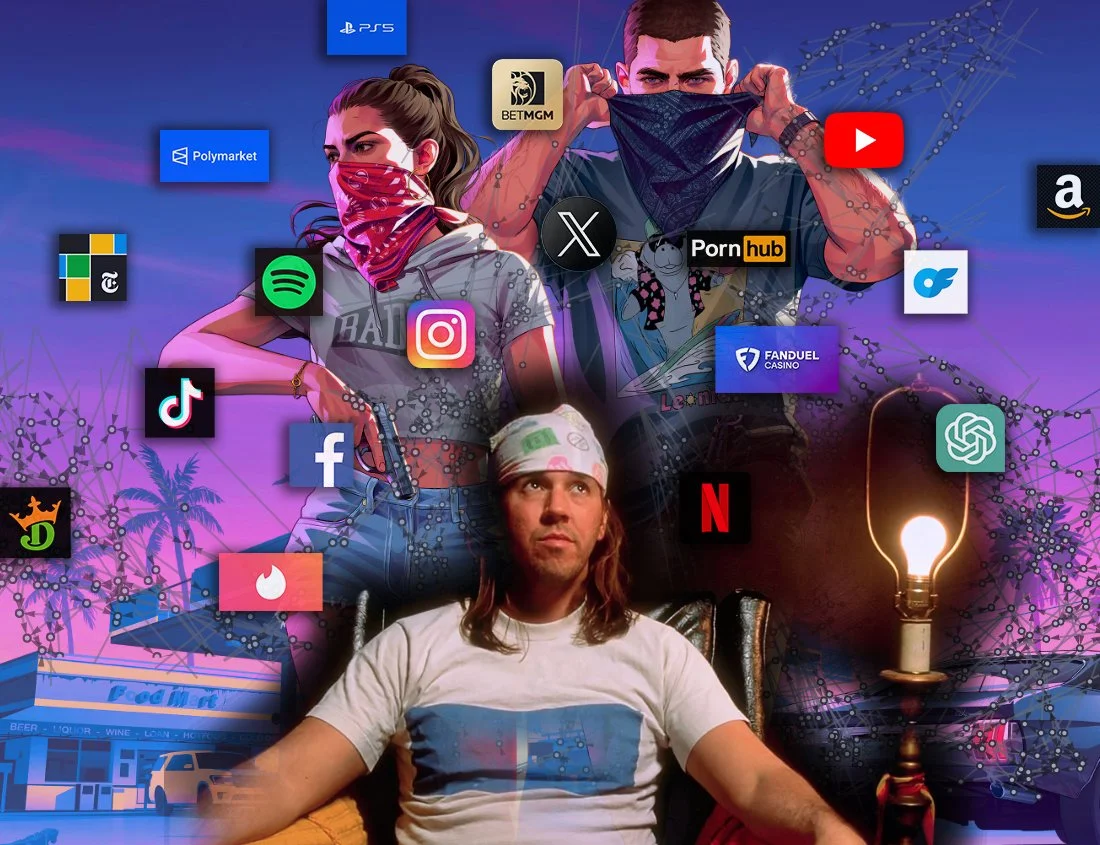
In David Foster Wallace’s 1996 novel Infinite Jest, the macguffin of the story is a video cartridge called ‘The Entertainment’. The contents of which are so seductive, and so perfect, that anyone who watches it falls into such a state that they forget to eat or sleep; and they eventually die. ‘The Entertainment’ works by giving the human mind everything it thinks it needs, and everything it feels is good. Yet of course in reality, in the real world, life itself slips away.
Even in the seemingly tame media era of television, radio, cassette tapes, and compact discs, Wallace was uniquely attuned to the effect ‘entertainment’ could have on the human mind. He could see where society was headed, and the dangers that increasingly seductive entertainment would pose in the future. In his famous interview with writer David Lipsky, I remember him ruminating on the potential of ‘virtual reality pornography’. He could see a future where the pornography got so ubiquitous and visually seductive, it would become irresistible.
Sadly, David Foster Wallace committed suicide in 2008. This meant he never got to see his predictions about entertainment come true with the proliferation of the smartphone. Nor would he get to see the full effects of social media, artificial intelligence, or ‘virtual reality pornography’. Yet the tension he highlighted - the struggle between the human mind and the entertainment mediums it creates - is as relevant now as it has ever been.
In 2026, there might not be one single media item that wields immense power like ‘The Entertainment’ in Infinite Jest. Instead our minds have been lured into distraction and apathy via multiple digital mediums. Whether it's our smartphones or streaming services; our consciousness has unlimited off ramps to escape the world around us. For young men, the holy trinity of video games, online gambling, and digital pornography combine to create a dopamine fever dream. An existence where the real world only serves as a transit point from one escape to the next.
Recently, an extended trailer video was released for the upcoming video game Grand Theft Auto 6. As I watched and felt my mind being swept into the possibilities of the endless stimulation the game could provide - I couldn't help but think of ‘The Entertainment’. The graphics and presentation have become so life-like, it's almost like the game is a live action movie come to life. Except in this medium, a player is able to fully embody the characters instead of simply watching. There is a huge difference between being able to export your consciousness into a digital avatar versus the passive voyeurism of watching actors on a screen.
The great Marshall McLuhan coined the phrase ‘the medium is the message’. The meaning of which is that the content of a medium matters less than the effect the medium has on the world around it. This concept has proven to be so true, it is almost axiomatic at this point when considering human affairs. Yet as digital technology has continued to improve, there is a secondary concept that seems to be true also. While the medium will always be the most important message, the quality of the medium matters as well.
25 years ago, I remember playing the earliest versions of Grand Theft Auto. These versions were probably either 16bit or 32bit graphic quality, and featured a simple, aerial view game play perspective. The lower graphic quality of the game meant the experience was closer to playing Ms. Pac Man or Super Mario Brothers from the early 1990's. These games didn’t seduce your whole consciousness. Rather they enabled an almost trance like state linked to focus and hand-eye coordination.
Today's open world games like Grand Theft Auto 6 allow the human mind to engage almost every aspect of its being. Instead of escaping life for a moment of trivial distraction, you can literally inhabit a new life in a digital world. The granular details of life, like what clothes to wear, whether to exercise, or how to respond to your partner's texts are all playable variables in Grand Theft Auto 6. The realism of the game also allows for the player to establish a deep emotional and even physical connection with their digital co-star. This has already led to social media discourse as to whether someone who spends too much time involved with their digital paramour is actually cheating on their real world partner.
If we have reached the point where a video game is able to affect a real world relationship in the same emotional way an actual human housewrecker would; then we have reached a point where ‘entertainment’ is no longer a passive medium at our command or disposal.
Our smartphones along with social media have created a reality where the modes of everyday life are blurred with entertainment. We communicate, consume news, look for love, and shop through apps which are designed to stimulate our minds the same way entertainment does. Not to mention that the physical medium of the phone itself is like a pack of cigarettes for a smoker. It sits in our pockets to offer periodic hits of pleasure. We don't think about it when it's there; but if it goes missing, our minds can focus on nothing else.
One theme of David Foster Wallace’s work was that the more we give ourselves away to something on an addictive pathway, the less we experience actual life. But what then happens if life itself becomes merely moments of addiction and entertainment on random levels of repeat? What happens when artificial intelligence allows us to create instant, personally tailored entertainment on demand? What happens when our psyche can feed every impulse with not just low-fi visual stimulus; but the super seductive, immersive Grand Theft Auto 6 kind?
I don't think it is a coincidence that the merging of actual life and entertainment has coincided with the rise of autocracy, and a decline in educational competency. This is not to say that every individual needs to be a super achiever in math or reading. It is simply to say that it is hard to ignore that educational achievement is going down while our technological tools are increasing. A mind that is stimulated and conditioned for short bouts of electronic fueled dopamine, is not a mind ready for contemplation, reading, or learning.
And when politics and news become entertainment, the minds of a population become highly susceptible to propaganda and autocratic movements. All that has happened surrounding the rise and reign of President Trump is due at least in part to the effect digital mediums have had on the US population.
When the human mind gathers information through social media, or Facebook newsfeeds, it is not in a mode of contemplation or rational thought. Rather it is getting seduced by an algorithm on a medium that works on an addictive pathway. News and information become objects to deliver the same dopamine hit as digital gambling or pornography. They become instruments to chase a feeling rather than tools to inform and educate. Authoritarian regimes seek to create realities where truth and fiction blur into a fever dream where the mind is lulled into quiet obedience. A reality where news and information function as entertainment does, is a reality suited for authoritarian control.
In Nicholas G. Carr’s 2010 book The Shallows: What the Internet Is Doing to Our Brains, he shows how the entertainment and communication mediums of the past affected our brains differently than contemporary digital mediums. Carr points to practical, science based evidence that highlights shortened attention spans, and cognitive changes in relation to digital mediums. The fact that there is hard evidence that digital mediums have changed the nature of our consciousness means that generational nostalgia isn’t purely romanticized remembrance.
Many of my generation look back fondly on their time growing up in the 1980’s and 1990's. The entertainment mediums of the time didn't completely consume our consciousness, or warp reality. Instead, they functioned as objects within a reality still dominated by the natural evolved functioning of the human mind. That is to say reality was a place that had items of entertainment within it. It was not a place left vacant by the realm of entertainment itself.
Back in the 1980’s and 1990’s, stories and fantasies were still conveyed by books or comic books. A mind that reads is one that is still conditioned for deep thought and contemplation. Physical books are not a medium that removes the mind from reality. Rather they enhance a mode of being in the mind that aligns with navigating reality better.
Even the experience of consuming movies was less aligned with pure escapism than it is today. Going to the movie theater was an experience born out of necessity. There were no streaming services or cable options for boundless home entertainment. Also the films at the time could not rely on visually immersive computer generated effects. This meant even the grandest of sci-fi adventures needed practical, physical effects. The effect this had on the mind of the viewer is subtle, but it did ground the film viewing experience in reality.
Putting aside whether the music of the day was ‘better’, it cannot be denied that the way we experienced music was more aligned with physical reality. The musical mediums of the time (radio, cassette tapes, compact discs, and records) meant that musical consumption had to be done in the physical world. The experience of going to a record store was a part of everyday life. As was the physical handling, and storing of the musical mediums themselves. This meant that the way music was experienced happened in alignment with the natural mind. Versus today where our digital diet of songs happens on the same addictive pathway as all the rest of our digital lives.
For young men, the act of self pleasure in the 1980's and 1990's consisted of Playboy magazines, Victoria's Secret catalogs, and physical pornographic mediums. Sometimes even the low-fi, scrambled XXX channel on basic cable proved to be enough stimulation. I remember shock jock radio host Howard Stern mentioning how in the 1960's he would have to set up a literal film projector in his parents’ basement to consume pornography.
The point is that in order to feed a natural urge in the past, the male mind was not completely taken out of reality. The pornographic mediums of the day were not able to feed total addiction. Whereas today a young man can indulge any visually seductive fantasy for as long as he chooses to do so, from the ease of any internet connected device. This is what David Foster Wallace meant when he spoke about the impact of ‘virtual reality pornography’. It's like giving a crack addict unlimited access to drugs 24 hours a day. There is no way the outcome can be good. And there is no way that person's mind can experience real life in a positive manner.
When the manner in which we move through reality becomes intertwined with entertainment, our consciousness is pulled away from modes that provide actual meaning. When the entertainment mediums we consume become so seductive that they seem preferable to experiencing actual life, we become numb to the people and the world around us.
In 2026, humans might not have created one cataclysmic medium like ‘The Entertainment’ in Infinite Jest. But we have created a world where ‘The Entertainment’ is everywhere. A reality where our minds are hijacked into a false sense of self, and blocked from experiencing what it really means to be a human being. So instead of being left paralyzed by stimulation, we move through life zombified. Thinking we are alive, but in reality we are only half awake. Chased by a gnawing sense of what it feels like to have a mind truly free, and in harmony with the world around it.