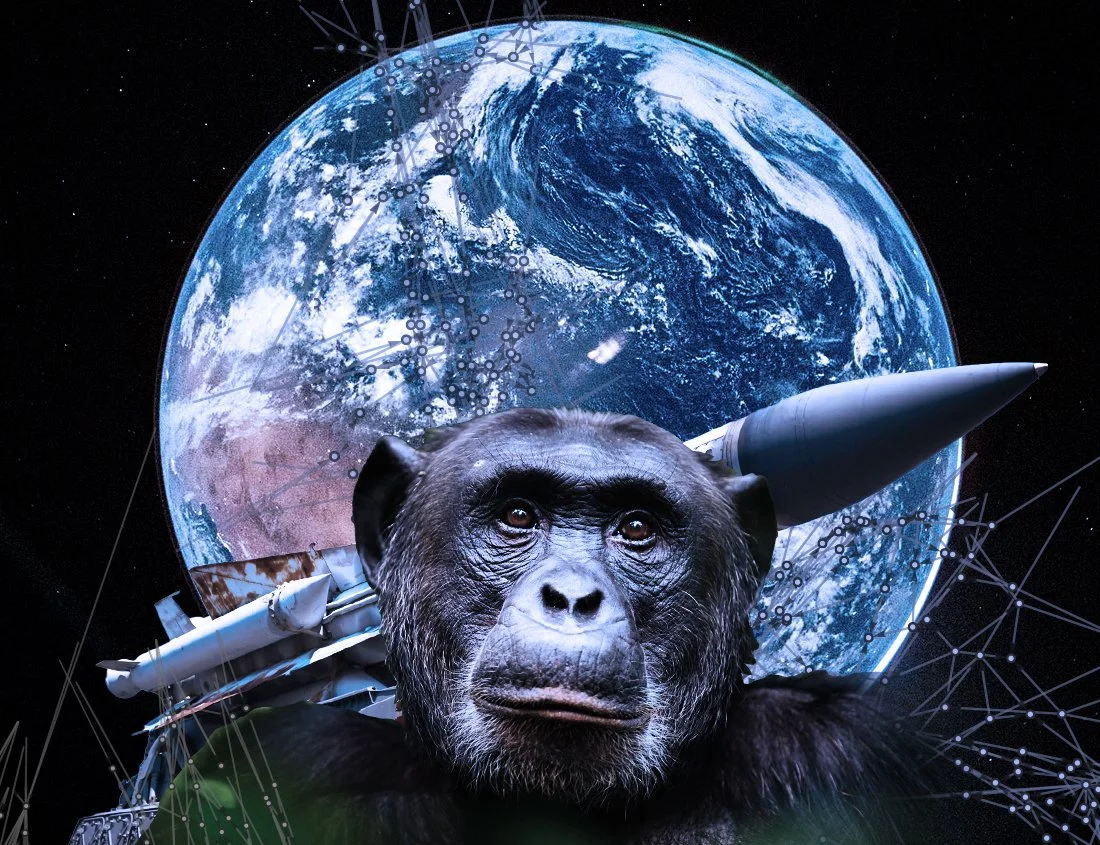
For the last eight years, the world’s largest group of wild chimpanzees has been mired in a ‘civil war’. The protracted dispute began without religious differences, ethnic differences, philosophical disagreements, opposing political ideologies, or differing economic philosophies. The war just emerged as a natural product of evolved behavior. Before the war, the nearly 200 Ngogo chimpanzees at Uganda's Kibale National Park were a close knit group that displayed cooperation and a relatively peaceful coexistence.
Aaron Sandel, the lead scientist studying the chimps, said that before the war these were ‘chimps that would hold hands’; but now they are ‘trying to kill each other’. Since 2018, Sandel and his team have logged 24 killings, including 17 infants. Some of the violence has included group attacks where 5 to 10 chimps from one side pummel a single ‘enemy’ chimp. The results of the beating might even include the out numbered chimp getting his testicles ripped off while being pinned to the ground.
Scientists believed that increased group size, competition for resources, and ‘male on male’ competition for mates might have helped ignite the war. Yet they cited three important events that might have led the Ngogo chimps down the road to conflict.
The first were the deaths of five adult male chimps, and one female chimp in 2014. The cause of their deaths remain unknown, but their demise might have caused a sudden weakening across the social fabric of the group.
In 2015 there was a change in the alpha male of the group. This change aligned with the first observed separation between the two chimp subgroups that would eventually go to war. The thinking here is that the change in dominance hierarchy caused ‘increased aggression and avoidance’ in the chimpanzees.
The third event happened in 2017, a year before the final break between the sub groups. 25 chimps died as a result of a respiratory illness outbreak. The dead included four adult males and ten adult females. According to scientists, one of the adult males who died was ‘among the last individuals’ to connect the two sub groups.
The Ngogo chimps occupy the same overall reality as you and I. Their nature as a species is closely related to ours as they share 99% of our DNA. Even though our consciousness is more evolved than theirs, our basic mode of being in reality is the same. The external world interacts with the evolved nature of our brains, and we act in response.
Chimpanzees are trapped in this reality. One where the mental confusion about the world around them is impossible to break. Reality imposes upon them, they react, reality responds, and they react again. There is no real ability for them to step outside of this chain, and examine the nature of their situation. As human beings we suffer within the same binds of reality. Yet we do have the ability to philosophically reflect on, and counter the nature of our situation. Yet as evidenced by the history (and current state) of humanity, the unavoidable missteps of the Ngogo chimps are frequently repeated as avoidable blunders by the supposedly superior human race.
For me, the best and most accurate diagnosis or description of the nature of reality concerning conscious beings lies in Buddhist philosophical thinking. This is not to say Buddhist thinking is the only path to truth, or that is 100 percent correct, 100 percent of the time, it is just to say that it makes the most sense to me considering what I have been able to intellectually consume over my time on this planet.
One of the foundations of Buddhist thought is the nature of ‘suffering’. In our reality, suffering is all around us. Our lives are backdropped by the constant fear of death, while the world around us ages and decays. Yet this suffering can also be seen as being trapped in a reality where we are controlled by our impulses and emotions. We are embedded in an interdependent world where our brains dictate our behaviour based on sensory input from the external world, and others around us. We confuse our actions as those of an independent, unchanging self, and assume the same for others. Being captured in this confusion is why suffering is the constant state that defines our reality.
As mentioned above, the Ngogo chimps are trapped within suffering. They have no ability to navigate their minds or emotions when group social bonds become strained due to death or disease. Nor can they examine their feelings when their minds turn to competition for resources or mates. They are stuck in a reality where they are at the mercy of evolution, their brains, nature, and external events that are out of their control.
Left unexamined or uninterrupted, this reality inevitably leads to conflict, hate, war, and destruction. The violence now gripping the Ngogo chimps was an inevitable conclusion to existing in reality without the ability to understand it. As human beings, we often find ourselves in the same position. Yet because of the nature of our consciousness, our descent into violence and hate doesn’t have to be predetermined by fate. We can foster empathy, compassion, cooperation, and understanding. Or in a Buddhist sense, we can mitigate the suffering for ourselves and those around us.
During the week that the story of the Ngogo chimps was gaining world attention, there were two other current events that embodied the two realities human beings can create for themselves. One was the war between the United States, Israel, and Iran (the Iran War). While the other was the Artemis II moon mission. One event was (and still is) an example of the human mind trapped by confusion and suffering. While the other was a unifying example of cooperation, interdependence, compassion, and understanding.
Like the conflict among the Ngogo chimps, the Iran War is a product of minds unable to perceive the true nature of the world around them. This ignorance leads to mental constructs like ‘us versus them’, and the belief that one’s own selfish interests are essential and primary. In terms of the Iran War, chief among these interests is religious belief. Each belligerent in the conflict (the United States, Israel, and Iran) has reified their religious beliefs to the point that they see war and killing as a divine right. Or their reification of religion has forced them to see others not aligned with their beliefs as threats and enemies.
As a metaphysical system that structures the entire nature of reality, religion naturally lends itself to reification by the human mind. With no disrespect intended to those who practice religious beliefs, I do believe all human religions originated from human thought - not supernatural inspiration. They are systems to convey morality, philosophical ideas, and settle the human mind amid the difficulties of life. Yet if they are reified to the point that entire nations structure their politics around them, conflict becomes inevitable. Additionally, when an individual reifies religion to the point that their entire life is defined by it, it can become difficult for them to view those different from them with empathy and compassion.
The Iran War is fueled by religious reification. But it is also fueled by an autocratic president who has what can generously be described as a ‘warped’ view of reality. There are few people on the planet who embody the dysfunction that comes from a misguided view of their sense of self (and the world around them) than President Donald Trump. Consumed by narcissism, status seeking, and his own impulses, President Trump engages with reality in a manner that resembles the consciousness of the Ngogo chimps.
The Ngogo chimps exist in this reality in a kind of ‘autopilot’ setting. Their actions are taken without any true sense of self reflection or questioning. They are at the mercy of their evolution and external stimulation. This is why when the social bonds that held them together began to break, they were unable to adjust, and descended into violence. As the world around them changed, their brains guided them in a direction they had no choice but to follow.
President Trump is mentally bound by the same constraints. With a famously narrow attention span, lack of impulse control, and a megalomaniacal sense of self; Trump exists very much on an ‘autopilot’ setting. His chief driver has always been his sense of his own greatness and status. Everything he does is in service of a hyper-reified (and false) view of the nature of the self. This is not only why he was a natural fit to become an autocratic president - but it is also why he has been so easily manipulated by countries like Russia and Israel.
Trump’s false view of himself led him to the belief that conquest in war would make him a great man. It also allowed him to be completely morally divorced from the consequences of his actions. Someone who views themselves as singularly important is unable to have empathy for other human beings.
This kind of mental confusion makes it easy to carry out massive bombing campaigns, or threaten the annihilation of a whole civilization. When the reification of the self is taken to the extreme, it turns other human beings into means rather than ends. Everyone outside of one self becomes expendable, or a tool to be used for personal gain. This has always been President Trump’s standard mode of consciousness; and it is why he was able to launch the Iran War so recklessly.
Human war and chimp war arise from the same confusions about the nature of the self, and reality. But only the chimps have a legitimate excuse for their inability to avoid disaster. Human beings on the other hand have the ability to see reality for what it is. This in turn can lead to a moral outlook and practice that fosters empathy, peace, and cooperation. The question is, how can this happen, and what does it look like?
For the human mind to see reality as an interdependent, cohesive whole, rather than a landscape of separate, independent entities; a perspective shift is usually needed. Mental practices such as detachment, mindfulness, or meditation can allow an individual mind to see the world for what it is. Yet sometimes an actual, physical perspective shift can do the trick as well. Such was the case with the Artemis II moon mission that occurred at the same time as the Iran War was dominating the daily news cycle.
There is something about space missions in general that cool the tribal fires within the human mind. Whether it's the International Space Station, or the now retired Space Shuttle missions, you'd be hard pressed to find people who didn't wish their crews success or safe passage. The same could be said for the Artemis II lunar flyby. The divide and vitriol that plagues social media fell away when it came to the Artemis mission. On this one topic, the hatred between ‘the left’ and ‘the right’ seemed to give way to universal support and goodwill.
The Artemis mission provided a lens for the human mind to forget its sense of self. It offered a pathway to a mental place where our impulses give way to perspective. A vantage point that shows us we are all embedded within a larger reality that exists far beyond the reification of our own wants and desires. A mode of being where our feelings and differences are not essentialized, but seen for what they are: temporary and illusionary conventions emerging from a deeper reality.
For the Artemis astronauts, this shift in perspective was extremely literal. As they rocketed into Earth’s orbit, and then began their journey towards the moon, their view of Earth gave them a glimpse into the true nature of reality. This in turn led them to a moral perspective that embraced a notion of empathy, understanding, and cooperation. One of the astronauts on the mission, Victor Glover, summed up this perspective shift during a media interview while in space:
’As we are so far from Earth and looking at the beauty of creation, I think, for me, one of the really important personal perspectives that I have up here is I can really see the Earth as one thing. We're all one people.’
Sentiments like this are often taken to be naive or corny. But these reactions matter little if the sentiment that causes them is true. If one chooses to reify their initial feelings when it comes to authentic moral sentiments, they begin to fall into the same trap as the Ngogo chimps. Acting upon something that doesn't necessarily deserve to be the signifier of action.
The perspective that the Artemis astronauts gained of reality (and briefly gave to humanity), could be seen as a kind of awakening. Within the tradition of Mahayana Buddhism is the notion of the ‘bodhisattva path’. This is the path that an individual travels down towards a full recognition of the reality they inhabit - or what a Buddhist might call ‘full awakening’. In the Mahayana tradition, this awakening is intended not for personal enlightenment, but to benefit others through compassion and generosity.
In the Mahayana tradition, seeing our reality for what it is (interdependent, impermanent, and selfless), leads to virtuous moral behavior. When one is able to see reality as an interdependent whole, it becomes much harder to act with enmity towards others. For the recognition of interdependence removes the ability to hate or mentally construct ‘enemies’. When impermanence is recognized, the trials from life, and the emotions that follow are recognized as temporary. They are seen not as objects to be reified and acted upon. Rather they are recognized as temporary phenomena that will come and go if you let them.
When selflessness is recognized, one can move through the world without greed, ego, or constant impulse indulgence. This then allows for generosity and compassion to flourish as one’s view of the world becomes externally focused; not internally bound. Through their journey into space, the Artemis astronauts took the express route down the bodhisattva path. They were able to see reality in a way that many human minds cannot.
The Ngogo chimps will never be blessed with the perspective of space travel, or Buddhist philosophical thought. They are forever trapped within an illusion. An illusion that leads each chimp to believe they are an independent entity forced to operate strictly in self interest. They cannot see their emotions or impulses as temporary phenomena. For them, these temporary things are permanent instructions to act and engage. Being trapped in this illusion led them to violence, hatred, and war.
Human beings succumb to the pitfalls of this illusion time and time again; with the Iran War being one of the latest examples. The Artemis mission was an example of how human beings can break the illusion, and move to a higher state of being. Sadly, in modern times, it seems like humanity is losing the battle to being trapped in illusion, rather than moving towards a permanent awakening.