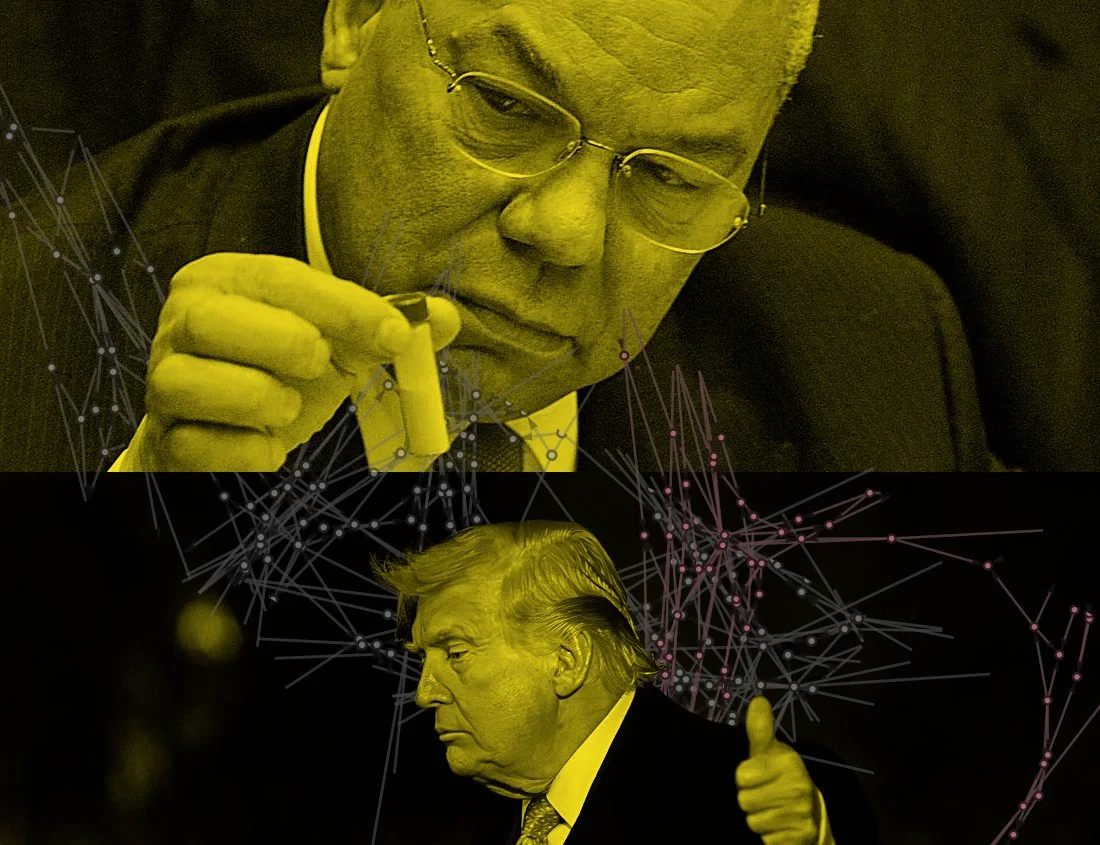
In February of 2003, then US Secretary of State Colin Powell presented America’s case for invading Iraq to the United Nations. Powell’s reputation for honesty and integrity meant that his words carried heavy weight with the American people. If Colin Powell (a man chastened by the horrors of the Vietnam War) said America had to fight; then America needed to fight.
Powell’s presentation came towards the end of a year-long propaganda campaign to convince the American people that Iraq was pursuing (and had) weapons of mass destruction. Major news outlets like CNN, MSNBC, and the New York Times all towed the government line. The narrative describing Iraq as an imminent threat was presented with few deviations.
At the time, I lived in Long Island City, Queens - near Vernon Boulevard and 47th avenue. A five minute walk from my apartment revealed the United Nations building directly across the East River. Gentrification had yet to begin in earnest so the sightline was relatively free of tall luxury condos taking in the view for themselves. I remember watching Colin Powell hold up a vial of ‘anthrax’ in front of the world - which in hindsight was a clear effort to persuade by fear. My cross-river proximity to the event provided the kind of memory only closeness can leave.
The time period between the September 11th terrorist attacks in 2001, and the beginning of the Iraq War in 2003 was very ‘covid-like’. Meaning that it seemed like reality shifted to a different dimension for a time. The country was united - and not in a fake way either. Though it didn’t last very long, there truly was common empathy, affection, and patriotism across political lines. There was also a sense of real fear. Osama Bin Laden, the leader of the group behind the September 11th attacks continued to threaten the United States, while smaller terrorist plots were being discovered, and thwarted.
The terrorist ‘threat level’ fueled by media speculation and government warnings cycled upwards and down. Secret intelligence reports worried that a nuclear bomb was going to be smuggled into New York City. I remember at one point a warning went out that there could be chemical attacks coming on the subway. For about the next week, subway rides consisted of all the passengers watching one another intently instead of the usual ‘mind your business; eyes down’ mode of subway travel.
This was the time period that birthed the Transportation Security Administration (TSA), and the US Department of Homeland Security (DHS). Government security bureaucracies intended to ‘secure the homeland’ in the new era of asymmetric terrorist threats. The modern era of mass domestic surveillance emerged from this time period as well. At the time, these security initiatives were largely accepted by the US population. It cannot be understated the amount of psychological shock unleashed by the September 11th attacks. For many (myself included), ‘ontological shock’ would be the better description. The nature of reality itself had changed. So it was easy to accept things that now seem foolish and unwarranted in hindsight.
The most important, and most consequential of these things was the Iraq War. For over a year leading up to the beginning of the war in March of 2003 the whole thing seemed like a forgone conclusion. The ‘debate’ leading up to the initial invasion was carried on cable news programs with titles like ‘Countdown to War’; or ‘Iraq in the Crosshairs’. Blinded by the mental disruption of the September 11th attacks, I believed going to war was the right decision. Yet as the zero hour grew closer, opposition within the American population began to increase.
My father, an ardent opponent of the Vietnam War, opposed any American aggression towards Iraq. Our arguments grew so fierce, that at one point a waitress at a restaurant jokingly asked if she should remove the knives from the table. My father would say he had similar arguments with his father about the Vietnam War. Well to his credit, he was right then, and he was right about Iraq.
President George W. Bush, members of his administration, and certain members of the media used various lines of storytelling to convince the American public that invading Iraq and getting rid of its leader (Saddam Hussein) was necessary. There were tales of efforts to obtain nuclear material, mobile biological weapons labs, and relationships with terrorists. And there were winks and nods that Saddam might have been involved somehow with the September 11th terrorist attacks (he wasn’t). Bush’s Darth Vader-like vice president (Dick Cheney) even visited the CIA in person to pressure intelligence agents to find reasons to support a justification for invasion.
At the time, there was a feeling that the whole case the administration was presenting was flimsy. Later on it would be revealed that the Bush administration felt that whatever ‘case’ they presented would be irrelevant once US troops discovered Saddam’s weapons stockpiles. This discovery would of course never happen - because there were no weapons to be found.
There was a flawed ideological foundation underpinning the conception of the Iraq War. Arising from neoconservative (neocon) thought at the time, the Bush administration sought to turn Iraq into a liberal democracy by force. There was a belief among the neocons that if democracy could begin to flourish in Iraq, it could spread through the Middle East. This in turn would magically solve all the problems that had plagued the region for decades.
This earnest, yet naive thinking might have summed up the Iraq War. Yet it also described the President who ultimately made the fateful decision. President George W. Bush was a man out of his depth. The aftermath of the September 11th terrorist attacks had reduced his worldview to absolutes coloured in black and white. There was good, there was evil, and you carried the torch for either one or the other.
Bush tried to appeal to the better angels of the American populace by constantly stating the United States wasn’t ‘at war with Islam’. I think he even visited a mosque, and Muslim American leaders in the weeks after the September 11th attacks if I remember correctly. In the years following the winding down of the Iraq War, many voices on the left would see George W. Bush as an evil figure. After all, his actions led to the deaths of hundreds of thousands of people. Yet I always saw Bush as more incompetent than evil.
He was simply a man who was bad at his job. He was not devoid of empathy or compassion. This was evident in his post-presidency as he painted portraits of wounded soldiers. It was almost as if he needed a silent catharsis for the weight of the mistake he could never admit. Some historians believe that weight - the burden of starting an unjust, and unnecessary war, hastened the death of former US President Lyndon Johnson. The nightmare of the Vietnam War ruined Johnson’s presidency and seemed to evaporate his very soul until he died a few years after leaving office.
Both the Vietnam War and the Iraq War were bolstered by some sort of Congressional authorization. In October of 2002, the US Congress voted to authorize ‘military force against Iraq’. The leadup to the vote was covered heavily by the traditional media at the time. One has to remember this was still a time where news was largely consumed via radio, newspaper, regular television, or cable news. This meant that the attention of the country was largely focused and coherent. Unlike today where information is scattered, digitized, and personally curated.
The discourse leading up to the vote, the vote itself, and the political repercussions from the vote all meant that democracy in America was still functioning. Functioning democracy means a kind of regular order or process. It does not mean the results of that process will be right, correct, or good. At the time of the Iraq War vote, Hillary Clinton was representing New York state as a US senator. Her vote in favor of authorizing the use of military force in Iraq was seen by many as the deciding factor in her failed 2008 presidential bid. She lost the Democratic nomination to someone who had voiced opposition in the lead up to the war; a fellow senator named Barack Obama.
The point to all this is that the Iraq War, despite all its ills, was still a war shaped by the forces of democracy. As the war began to go badly, media coverage was constant and unrelenting. When the torture and abuse of Iraqi prisoners at Abu Ghraib prison was uncovered by CBS News, a firestorm ensued. Soldiers were charged with crimes, and the media began to follow the trail of how ‘enhanced interrogation techniques’ (or torture) emerged as US policy after the September 11th attacks. Again, democracy doesn’t mean that bad things never happen. Democracy means that when bad things inevitably happen there are checks, balances, and mechanisms to right the ship.
23 years after the invasion of Iraq, the United States once again finds itself involved in a major war in the Middle East. Except this time, the war did not emerge from democratic process, and it is not contained by democratic guardrails. Instead it is a war born from the nature of autocracy.
As of this writing, it has been over a month since the United States and Israel started to bomb Iraq’s neighbor to the east, Iran. President Donald Trump sought no congressional approval or authorization for his war on Iran - just as he sought no approval for his January military intervention in Venezuela. America’s autocratic slide has reached the point where the president is able to wield military power at his personal whim. Congress has abdicated its role as a co-equal branch of the United States government. So much so that when the opportunity came to check President Trump’s abuse of military power after the inception of the Iran war; the US Congress chose not to.
There was no case made to the American people about the need for military action before the war. The United States simply massed forces in the region while the Trump administration supposedly tried to negotiate with the Iranian regime. Trump’s chief negotiators were his son in law Jared Kushner and his friend Steve Witkoff. As unqualified emissaries of an autocratic government, Kushner and Witkoff have intertwined US foreign policy with personal business deals. Both men operate as an extension of their boss: purely transactional and devoid of any moral or ethical concerns.
The transactional nature of Trump’s autocratic government flows from his megalomania. Trump’s constant appetite for money, status, and praise has always made him a prime target for manipulation. In the eyes of many foreign actors, he is, as the Russians like to say, a ‘useful idiot’. This was recognized early on by the nation of Israel and its leader, Benjamin Netanyahu. The outbreak of the Iran War marked the successful culmination of Netanyahu’s efforts to cajole Trump into joining his messianic desires.
Trump was probably told that if he attacked Iran he would be remembered as a ‘great man of history’. He was probably lathered up with Israeli reassurance that the war would ‘be easy’, and that the Iranian regime would crumble quickly. Apparently Trump’s own ignorance led to him believing the Iranians wouldn’t close the Strait of Hormuz. One major flaw of autocratic leaders is that very often their hubris leads to ignorance, which in turn leads to disastrous decision making. This is then compounded by the fact that the nature of autocracy requires that the ‘dear leader’ is never given bad news.
The leader, in this case President Trump, draws those around them into a kind of autocratic fever dream. There are no strategic plans or policy. There are only the personal wishes of the person on the throne, and the reality they choose to endorse. In Trump’s first term as president, there were still democratic buffers between his autocratic desires and the US military. In his second term, all the buffers were removed, and the military became a tool to fulfill Trump’s desire for power and wealth.
Trump has tried to manipulate the economic reaction to his war of choice in an effort to forestall its dire consequences. He has either enabled, or participated in insider trading based on his remarks about the war, and their effects on oil markets. The Trump administration’s justification for the war has been a mix of lies, and convoluted reasoning. Their propaganda surrounding the war has been a weak cocktail of hyper aggression, juvenile videos, and the usual Trump nonsensical word salads. Trump’s cronies have also threatened media outlets who publish any ‘negative’ stories about the war.
There are autocratic regimes who are deadly serious and capable in the service of a grand ideology - and there are autocratic regimes that are unserious entities mostly concerned with holding power and self enrichment. Donald Trump’s regime is the latter. The problem with this is that when serious matters (like war) are treated with autocratic carelessness, average citizens suffer the most. It’s a little like the line from F. Scott Fitzgerald’s The Great Gatsby:
They were careless people, Tom and Daisy - they smashed up things and creatures and then retreated back into their money or their vast carelessness or whatever it was that kept them together, and let other people clean up the mess they had made.
For Trump, starting a war is like playing a round of golf, or stiffing a contractor who worked on one of his hotels. It’s just an action he can take based on feeling or impulse with little consideration about future consequences. Yet as of this writing the consequences of his actions have started to mount. Unless an off ramp is taken, the United States looks poised to send ground troops to fight in Iran. Crossing this kind of red line can make a four week war turn into a four year one.
The Iranian aligned Houthis in Yemen look poised to enter the war and threaten another vital shipping route. This in turn would send a further shock through the world economy. The greater the shock, the more likely another military power like Russia or China could be drawn into the fighting. Also, the longer the fighting drags on without Iran giving in, the unthinkable becomes a possibility. That Israel, motivated by desperation and messianic purpose, would use a nuclear weapon.
The world has seen violent cataclysm result from the megalomania of autocrats before. Yet there is another option instead of a World War II type conflagration. Low level, relatively contained, perpetual war is actually a benefit to autocratic leaders. When there is always an ‘enemy’ to be fought, there are always corrupt defense related deals to be made, and most importantly; ‘emergency’ measures needed on the homeland.
What Donald Trump has started seems poised to spin out from his control, if it hasn’t already. Yet it was probably within his mind before starting the war, that a contained military campaign would offer him greater power at home. ‘Iranian terrorist threats’ to the US homeland could be used as an excuse for emergency presidential powers that could justify interference with the coming elections. Not to mention that the opportunity for nationalistic propaganda would be substantial for America’s 250th birthday.
Trump might still try to use the war for domestic purposes. Yet his grand visions have already met a hard reality. Some of his military aligned supporters from the Iraq War generation have woken up to his broken ‘peace’ promises, and the vapid justifications for attacking Iran. Over twenty years ago, America bumbled its way into a war of choice, and a quagmire. Yet the country was still a functioning democracy, which allowed the war to be contained, and eventually end.
In 2026, America is under autocratic rule; and the Iran War is a product of that. There are few democratic guardrails left to keep the situation contained, or bring it to a stable conclusion. The situation will be determined by the whims of an autocrat. And as history shows, that’s usually bad news for the rest of us.