
‘A hypergraph is, instead of saying there is a connection between a pair of things, we say there are connections between any number of things. Instead of having two points connected by an edge, you say three points are all associated with a hyper edge.’ - Stephen Wolfram
In my view, there is an aspect to metamodernism that is physical in nature. Physical in relation to the structure of our reality. If this is taken to be true, it would mean that the concept of metamodernism doesn’t just serve as a kind of metaphysical metaphor, but partly as a descriptive notion of our material reality. Our digital connections function as a kind of lattice work underlying our subconscious (and conscious) experience. Metamodern oscillation, combination, feeling, entertainment, news, and information; it all flows through this lattice work. It might be no coincidence then that the entropy of metamodern metaphysics resembles the entropy of the physical reality underneath. If one were to view this through the lens of the ancient Greek philosopher Aristotle’s ‘four causes’, the ‘material’ cause of our metamodern reality would be the physical electronic systems and machines that we use. The ‘efficient’ cause (force or action) would be the agency of individuals while they use technology. While the ‘formal cause’ (ideal form), or ‘final cause’ (purpose) wouldn’t really apply. For there is no ideal form or final purpose for a metaphysical reality unless an active ‘God’ is considered a creator. And in my opinion, this is not the case (at least in the traditional religious sense). However, one could make the argument that in considering the physical aspect of metamodernism, the formal and final cause could be seen to relate to some notion of pure or ideal connectivity.
So if we have this metamodern metaphysical construct, that has kind of two parts, one abstract, and one physical, how best can one conceive of it? One possible way is through the concept of a ‘hypergraph’. In particular, the notion of a hypergraph as expressed by Stephen Wolfram, and The Wolfram Physics Project. Wolfram’s hypergraph is an attempt to discover a ‘theory of everything’, or discover the very nature of physical reality itself. This bold venture seeks to describe the ingredients and processes that gives rise to space, time, quantum mechanics, and every other aspect of our vast universe. If there is a creator somewhere who cooked up this universe we inhabit, Wolfram is trying to decipher its ingredients and recipes.
For our purposes however, it is not important that we get into the weeds of Wolfram’s scientific theory. Nor is it possible, considering my scientific aptitude reached its limit while almost failing high school level physics. Yet as a visual (and conceptual) allegory for our metamodern reality, only a surface description or understanding is needed.
Via various ‘points’ and ‘rules’, Wolfram’s hypergraph is constantly growing and changing. Branchlike structures flow and interact with each other. The relationships between aspects of the hypergraph lead to more hypergraphs describing the relationships. It is a deep, rich, organic-like structure that layers complexity upon complexity. Something changes, which causes something else, which affects a group of things, and so on. Wolfram’s theory supposes that the physical reality you and I perceive rests upon the constructs of this miniscule (yet massively complex) hypergraph. A visual conception of which can be seen here:
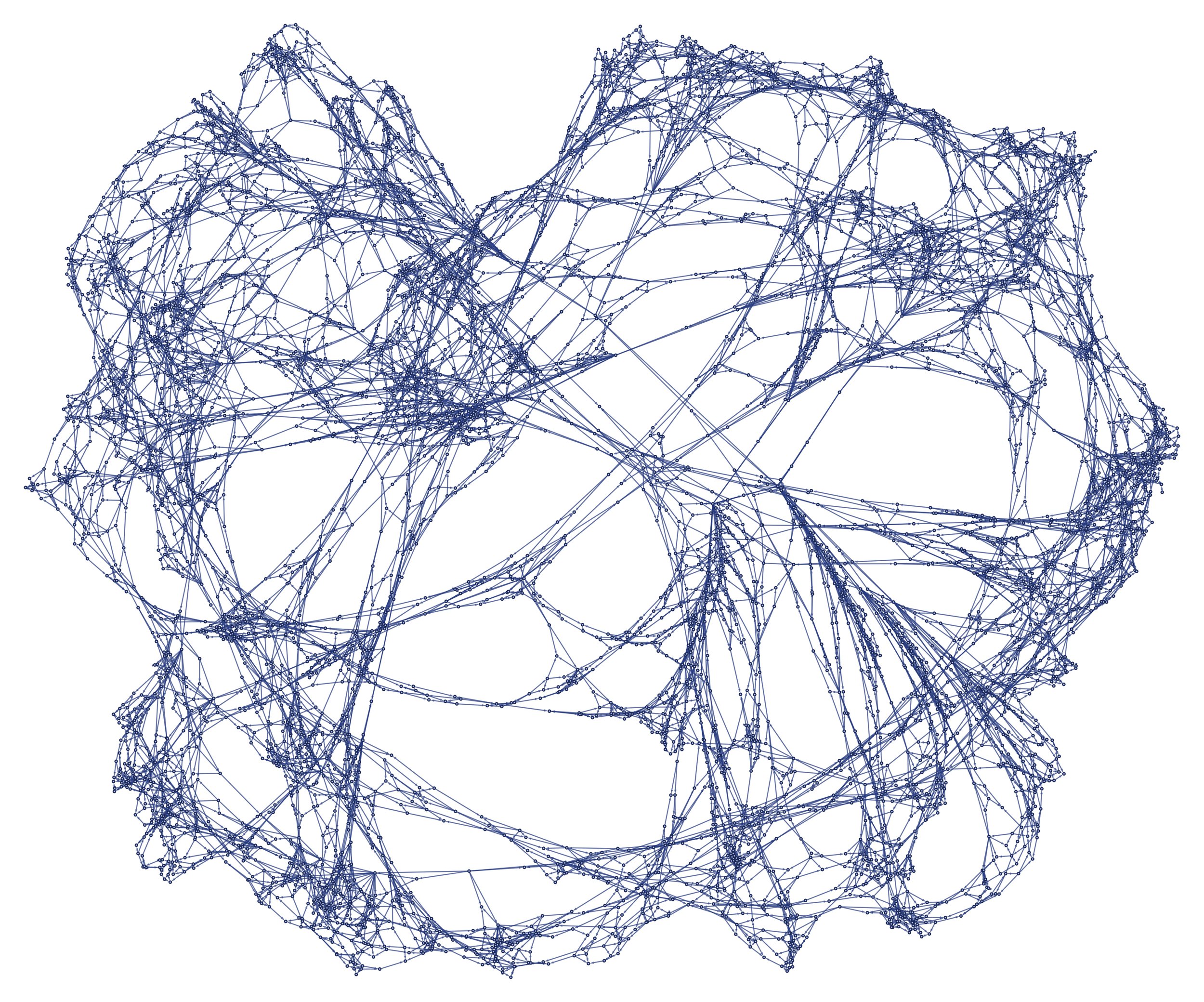
Credit: Wolfram Physics Project
Imagine then for a moment that the visual of the hypergraph represented not our unseen foundational, scientific materialist reality; but represented our abstract metaphysical reality, as well as our physical digital reality. The branchlike structures would be mostly our digital connections; but ‘pre digital’ ones as well (things like oratory, the written word, etc). While every aspect of our reality; every individual, every news item, every book, religion, emotion, historical fact, artistic movement, geographic location, or scientific discovery - it would all exist within various points of the hypergraph. Our digital connections would ignite the causal relationships across the hypergraph, and add layers of complexity. This would show our reality flowing and changing with no real center. In other words, the hypergraph would give us liquid modernity visualized. Thus, one might call it the ‘metamodern hypergraph’.
If we viewed time in a linear fashion in reference to the metamodern hypergraph, the inception of its current iteration would probably be around the 1960’s. Before this time any visual conception of reality would be a concentrated line or thread. Just a condensed linear progression forward, like a laser beam moving from one point to another. But by the time the cultural revolutions of the 60’s began to take place, the condensed thread or laser would begin to splinter. Slowly at first, then accelerated by the financial deregulation, changing media landscape, and the birth of the internet in the 1980’s and 1990’s. Yet the metamodern hypergraph wouldn’t take it’s current form until the advent of the smartphone, and the introduction of social media. These are the markers that propelled the metamodern hypergraph into accelerating entropy.
We occupy space in the hypergraph in a basic physical way. And though we have more ways than ever to travel in a physical sense, it is our minds that can move across the hypergraph at light speed. Like a spacecraft jumping across the galaxy from one star system to another, our minds can move from one perceptual experience to the next. We can cue up entertainment and historical items from throughout history. We can interact with people from around the globe at a moment's notice. We can consume news and information any which way we like, at any time. We can study religion, philosophy, cooking, woodworking, and everything in between. The metamodern hypergraph pulsates with streams of information and experiences. Yet this is all they are, naked substances, not tethered to any overarching meaning or truth.
There might be cohesive philosophical, or mental streams within the hypergraph. Like various religions or political constructs. But over time, as new generations come of age, it seems less likely that individuals will remain tethered to any of these. They are ‘free to roam’ so to speak. Free to construct their metaphysical reality as they see fit. This opens the door to the downside of our minds traversing the metamodern hypergraph. For we might indulge our curiosity and search out a historical item. Yet we might be consuming something out of context that reinforces our biases. Instead of interacting with people around the globe in a positive manner; our digital discourse might devolve into impulse fueled tribalism. We might consume reams of news and information, but without any way of knowing what is true or false. And we might learn things online whether the person teaching us is qualified or giving proper instruction.
It’s almost as if a young mind enters the hypergraph tabula rasa, or a ‘blank slate’. The only lasting guides being the basic elements of human nature. This unfortunate status would mean an individual is guided by their ‘passions’. Passions (human impulses) that lead one towards hedonism or tribalism. Remember there is no transcendent structure to guide the mind through the hypergraph, and mitigate the passions. Thus, human nature becomes a disproportionate causal actor within the hypergraph itself. Tribalism and hedonism become lenses through which reality presents itself. And the very human act of trying to fill the existential vacuum becomes a futile adventure. One where the physical body is stuck in place, but the mind roams the hypergraph in search of soulful nourishment that seems nowhere to be found. This situation then begs the question, how does an individual properly engage the metamodern hypergraph? How does one orient themselves, figure out what is true, and find meaning or transcendence?
Long ago, the ancient Greek philosopher Plato came up with an allegory to describe how an individual can start to know the ‘true reality’ of their existence. Described as ‘Plato’s cave’, the allegory describes the soul of an individual as being trapped within a body, which is in turn trapped within a cave. The body of the individual is forced to face the wall of the cave, while behind them a fire burns towards the exit. Via the flames, shadows and flickering images appear on the wall in front of the individual. The images constantly change, are untethered, undefined, and removed from actual reality. These images represent the world of ‘changing appearances’ or false perceptions. For our purposes they will represent what an individual sees from their position within the metamodern hypergraph.
Plato would describe a notion called ‘dialectic’, which could be taken loosely as a form of reasoning. A kind of recollection and contemplation of first principles or ‘essences’. A way for the individual trapped in the cave to realize their predicament, and eventually emerge from the cave and know true reality. This line of thinking would seem to make sense when applied to the individual positioned within the metamodern hypergraph. In order for them to understand and contemplate the true nature of reality, they would need some process or mechanism that enabled them to ‘leave the cave’. Something that enabled them to step as far away from the hypergraph as possible, and observe it in its totality. What then, would this modern form of dialectic look like?
The first act for an individual would have to be a realization that their perception is confined by their position in the hypergraph. A simple example of this would be when someone who has been indoctrinated into a certain religious belief is able to step outside of those mental confines and realize the broader philosophical world around them. Yet once the individual realizes their confinement, where can they venture to? What kind of territory lies outside of ‘the cave’ or away from the metamodern hypergraph?
The terrain on the outskirts of the metamodern hypergraph would have to be one of universals and first principles. Ideas and notions that are as ‘true’ as possible, and that have seemed to survive throughout the time human beings have existed on this planet. If an individual is able to enter this mental terrain, and use its vantage point to observe the metamodern hypergraph, I believe they can begin to positively navigate their way through the hypergraph itself. The individual can begin to make sense of things, do their best to figure out what is true, and find meaning or moments of transcendence. In order to find where to go, the individual needs to move to a position that has a view from nowhere.

The hard part in this metaphysical discussion comes when we arrive at the place where first principles and ‘true’ universals need to be defined. It is not the role for me or any other one person to define such things. Maybe a group of philosophers or thinkers could come to some viable conclusions that carried weight. But for the sake of this thought experiment, I will describe some of the first principles and universal truths that I feel are elemental enough to be used as one ventures out from the metamodern hypergraph. But again, this is an attempt done with humility, not one done with certainty or absolute clarity.
The first universal I can see is what Victor Frankl described as the human ‘will to meaning’. As I have discussed ealier, Frankl articulated his view that all humans are meaning-seeking creatures. That our lives are oriented towards this notion, and that we are driven by it. This notion seems very elemental and true in my eyes. In addition, the four realms of existence where we as humans derive authentic meaning seem to have remained constant over thousands of years. Those being, family, vocation, religion, and community.
Another universal that has sadly seemed to stand the test of time and human experience is that ‘more powerful human beings tend to abuse less powerful human beings’. Regardless of race, class, or any other secondary qualities, power in itself has a universal quality. It has its own universal energy that defines human interaction. This is not so much to think of power in the nietzschean sense, as a kind of driving force in humans. But more as a naked causal actor that emerges through different physical juxtapositions. This notion of power has more to do with sheer physical majorities or superior technology than psychological motivation. This concept also relates to the seemingly universal principle that when power is concentrated at the top of a hierarchical structure; it tends to be abused.
From a moral standpoint, the phrase from the Reverend Martin Luther King Jr. that humans should be ‘judged by the content of their character and not the color of their skin’ seems like a valid first principle. It’s very hard for me to come up with a counter argument that says, ‘hey, I think it would be better if we as humans judged people by their race, religion, gender, or sexual orientation’. Contained in King’s phrase is the notion that all human beings are deserving of dignity and respect. Again, it’s very hard for me to see how this can be invalid as a true universal principle. It also seems to be a principle that is essential for us to learn if we are to overcome our tribal impulses.
From an epistemological standpoint, one would take these (and other) first principles or themes, and use them to begin to gain knowledge and understanding about what they encounter as they traverse the metamodern hypergraph. They would act as an anchor or tethering line that would always allow an individual to retrace their steps, and find their way ‘home’ so to speak. They would allow the individual to have a certain structure to their experience, and provide a way to fill the existential vacuum. If we thought of this notion in terms of liquid modernity, the use of first principles and universals would be like using a ship to navigate the sea instead of simply being swept from current to current. Notions of truth, meaning, and understanding could emerge via an individual’s use of a certain kind of reasoning. And it is this use of ‘reason’, that I see as another universal, in that all human beings are capable of it.
I do not mean reason as a purely analytical function where one weighs empirical data and facts. But in a more human sense; one where the mind begins to control the passions. A mental place where the individual begins to realize their predicament in the metamodern hypergraph, internalize some first principles, and realize how their passions are stoked by the digital landscape. One could see this as a kind of ‘awakening’ or ‘enlightenment’. I am not a fan of this description, for it can become reductionist or sensationalized. But I cannot deny it does fit when one thinks about an individual realizing their broader reality.
As far as I can see, the metamodern hypergraph is not going anywhere anytime soon. Nor is the age of metamodernism. The German philosopher Hegel described a concept of ideas or history in terms of ‘thesis, antithesis, synthesis’. The thesis comes forward, which is pushed back on or refuted by the antithesis, which then results in a combination, or ‘synthesis’ of both. This concept seems to mirror the progression of modernism, postmodernism, and metamodernism. With modernism being the thesis, postmodernism the antithesis reaction, and metamodernism the synthesis of both. Considering this formulation along with the fact that metamodernism is partially a physical manifestation of our digital network, it would seem that the metamodern landscape will have some staying power.
If we do not destroy ourselves, I could see in the far future something like a ‘pan-modernism’, an all encompassing, unified reality. One where humans have merged with their digital creations to a point where instead of having to navigate reality, reality navigates through us. This would be a world of indistinguishable virtual reality, digital-human mind implants, the ability to upload consciousness, etc. But until then, we as individuals are stuck within our primitive human forms amid the metamodern hypergraph. If we are to survive and flourish, a general recognition of our predicament is needed, along with some broad agreement on prescriptions or ways of being. Otherwise, I fear our inherent tribalism and hedonism will lead to conflict, disaster, and unwarranted suffering. And maybe even our ultimate demise.

